AI for Pandemic and Epidemic Preparedness in a Warming World
Southern-led, responsible AI for climate-driven health threats



The Global South AI for Pandemic & Epidemic Preparedness & Response Network (AI4PEP) works to strengthen equitable and responsive public health systems that leverage Southern-led responsible AI solutions to improve prevention, preparedness, and response to emerging and re-emerging infectious disease outbreaks. Dr. Jude Kong and Dr. Emmanuel Musa speak here about AI4PEP’s work with Sarah Skenazy, Public Health Lead with CCAI. For Dr. Kong and Dr. Musa’s bios, see the bottom of this page.
Interview with Dr. Jude Kong and Dr. Emmanuel Musa
Skenazy: How does climate change impact pandemics and epidemics—how will a warming world impact global public health and what should we be planning for in terms of pandemic and epidemic preparedness and response?
AI4PEP: Climate change is fundamentally reshaping the landscape of infectious disease risk. Rising temperatures, shifting rainfall patterns, and extreme weather events are altering where pathogens and their vectors can survive and thrive. Warmer climates expand the geographic range of mosquitoes, ticks, and other disease carriers, increasing the likelihood of outbreaks of malaria, dengue, chikungunya, and other vector-borne diseases in regions that historically had low exposure. Flooding and storms disrupt sanitation systems, heighten waterborne disease transmission, and weaken already fragile health systems.
A warming world also accelerates the emergence of new pathogens. Environmental stressors push wildlife into closer contact with human populations, increasing opportunities for zoonotic spillover. At the same time, climate-driven displacement and food insecurity create conditions where outbreaks spread more rapidly and are harder to contain. This is why AI4PEP focuses on early detection, prediction, and preparedness because climate change is not only a health threat on its own; it is a multiplier of epidemic and pandemic risk. Our work helps countries anticipate where outbreaks may emerge and strengthen their ability to respond quickly and equitably.
Skenazy: The AI4PEP network has always stood out to me as an exemplary transdisciplinary effort. Can you outline the current scope of the AI4PEP Network—who is involved and what are the impacts and outcomes of your work?
AI4PEP: AI4PEP is a multi-regional, interdisciplinary network focused on the Global South and spanning Africa, Asia, Latin America and the Caribbean, and the Middle East and North Africa. We bring together data scientists, public health professionals, mathematicians, physicists, and community leaders from across the Global South to co-create responsible AI solutions for epidemic preparedness.
Our scope includes:
- Strengthening public health capacity for early detection, response, and mitigation of infectious disease outbreaks.
- Supporting governments, public health agencies, and civil society with AI-driven tools that improve surveillance and decision-making.
- Building local expertise through training, mentorship, and South-South collaboration.
- Developing real-world AI applications that address region-specific challenges in climate and health.
Our direct impacts include improved outbreak surveillance sensitivity, enhanced vector monitoring, more accurate disease forecasting, and stronger community-centered approaches to preparedness. Our hubs are already generating new knowledge and deploying tools that help health systems anticipate and respond to emerging threats.
Skenazy: What lessons have you learned about best practices for working towards AI solutions that center health equity? In your work across your network of local hubs, what guidelines do you follow to simultaneously map the risks of exacerbating inequities and implementing programs that reduce inequitable impacts?
AI4PEP: AI offers enormous potential for improving outbreak prediction, surveillance, and response but only if it is developed responsibly and with equity at the center. We entered this space because Global South communities are disproportionately affected by climate-driven health threats, yet they often lack access to the tools and data needed to prepare for them.
AI can exacerbate inequities when:
- Data used to train models excludes or misrepresents Global South populations.
- Tools are designed without community input or local context.
- Solutions are deployed without considering digital divides or resource constraints.
But AI can also reduce inequities when it is:
- Locally led and developed by researchers and practitioners who understand the context.
- Transparent and accountable, with clear governance and ethical safeguards.
- Co-created with communities, ensuring that tools reflect lived realities.
- Designed for low-resource settings, with adaptable, open, and accessible architectures.
AI4PEP’s model is built on these principles. We prioritize Southern-led innovation, capacity strengthening, and community engagement to ensure that AI becomes a tool for justice rather than exclusion.
Skenazy: Can you talk about a few specific recent AI solutions that you are working on in climate and health? What are some especially promising examples you have seen across the different regions you work in in the Global South?
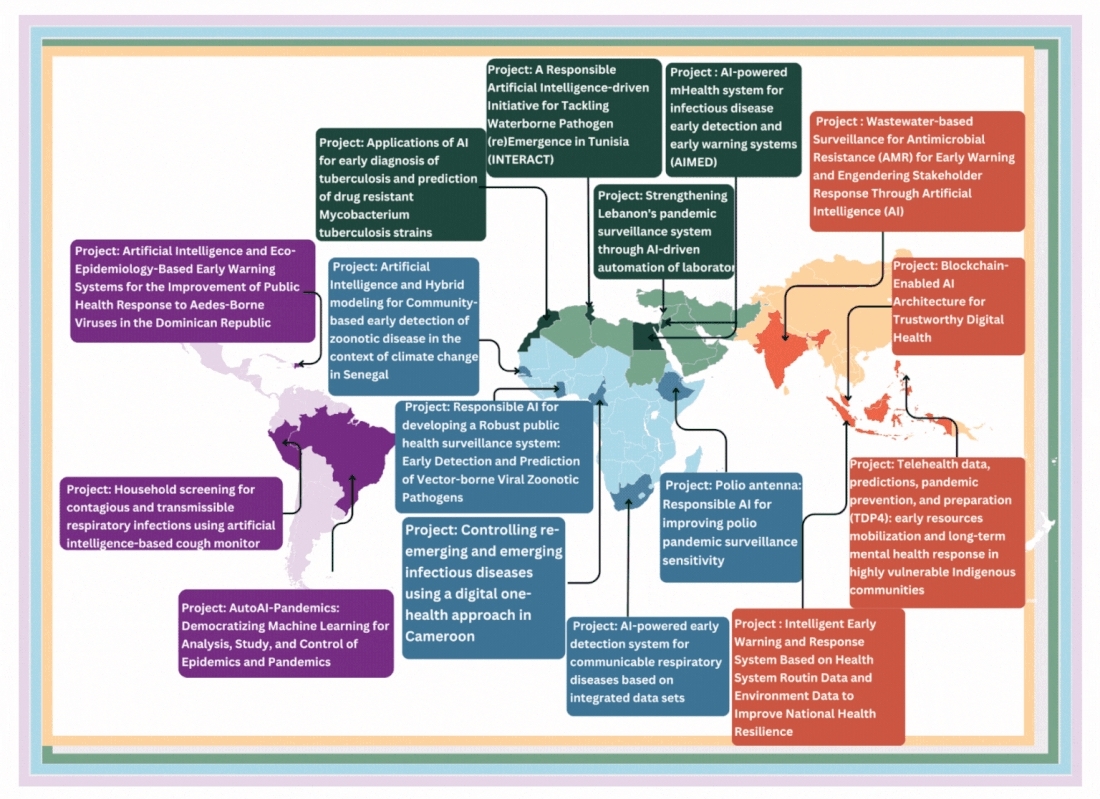
AI4PEP: Across our hubs, we are developing a diverse portfolio of AI-driven tools tailored to local climate-health challenges. Some examples include:
- Ghana: AI-supported mosquito surveillance systems that analyze vector distribution and predict disease risk under changing climate conditions.
- South Africa: AI-enhanced, low-cost air-pollution monitoring systems designed to fill critical data gaps in communities most affected by climate-driven health risks. They detect pollution hotspots and generate real-time pollution forecasts.
- Ethiopia: Responsible AI models that improve the sensitivity of polio surveillance, helping detect outbreaks earlier and more accurately.
- Malaysia: Blockchain-enabled AI architectures that enhance trust and transparency in digital health systems, which are critical for climate-related health emergencies.
- Philippines: Telehealth-driven prediction models that integrate climate and health data to support pandemic prevention and preparedness.
- Brazil, Tunisia, Palestine, Cameroon, Indonesia, Dominican Republic: Each hub is developing context-specific tools, from early warning systems to community-centered data platforms that strengthen resilience to climate-driven outbreaks.
These innovations demonstrate the power of locally grounded, globally connected AI research to address climate-health challenges.
Skenazy: We know that climate and health impacts are and will likely continue to be the most drastic in the Global South. What are the main barriers you see to equitable AI implementation across Global South regions? How do you address these barriers?
AI4PEP: Several structural barriers limit the equitable use of AI in climate and health:
- Data gaps and data colonialism: Many countries lack high-quality, locally owned datasets. When data is extracted without local benefit, it reinforces inequity.
- Limited digital infrastructure: AI tools often require connectivity, computing power, and technical capacity that are unevenly distributed.
- Lack of governance frameworks: Without strong ethical, legal, and regulatory systems, AI can be misused or deployed in ways that harm marginalized communities.
- Underinvestment in local expertise: Global South researchers are often excluded from agenda-setting and funding, limiting their ability to lead innovation.
AI4PEP addresses these challenges by building capacity, strengthening governance, and ensuring that communities and local experts drive the development and deployment of AI tools.
Skenazy: If someone in the computer sciences has a passion for climate change but is perhaps newer to the global health field, what skills and areas of expertise do you encourage them to develop? What is most needed in the field right now?
AI4PEP: AI4PEP is at the forefront of encouraging and supporting practitioners to cultivate a blend of technical, ethical, and contextual skills, such as:
- Technical skills: machine learning, geospatial modeling, time-series forecasting, natural language processing, and data engineering.
- Domain knowledge: epidemiology, One Health, climate science, and public health systems.
- Ethical and governance literacy: understanding bias, fairness, data sovereignty, and responsible AI frameworks.
- Community-engaged research skills: co-design, participatory methods, and human-centered design.
- Interdisciplinary collaboration: the ability to work with public health officials, policymakers, and community leaders.
What the field needs most right now is practitioners who can bridge disciplines, people who can translate complex AI methods into tools that are usable, trustworthy, and impactful in real-world public health settings. AI4PEP continues to prioritize these in our work across the Global South.
Additional reading and resources
- Learn more about AI4PEP’s project activities: AI4PEP performance dashboard
- AI4PEP website and LinkedIn
- AI4PEP Podcast Series
- AI4Mpox Ghana: Using AI to Prevent the Next Public Health Crisis at the Human-Wildlife Interface
- CCAI & AI4PEP presentation at the United Nations General Assembly Science Summit: session summary
Bios
Prof. Jude Kong is a professor in the Mathematics & Statistics Department at York University and the founding Director of the Africa-Canada Artificial Intelligence and Data Innovation Consortium (ACADIC). Additionally, he is the Executive Director of the Global South Artificial Intelligence for Pandemic and Epidemic Preparedness and Response Network and the Regional Node Liaison to the steering committee of the Canadian Black Scientist Network (CBSN).
Dr. Kong is an expert in artificial intelligence, data science, mathematical modelling, infectious disease modelling and mathematics education. His principal research program focuses on the use of artificial intelligence, data science, mathematical models and other quantitative methods to improve decision-making for clinical public health. During the COVID-19 pandemic, he has been leading an interdisciplinary team of more than 52 researchers from key academic and government institutions in nine African countries that have been using artificial intelligence to help government and local communities to contain and manage the spread of COVID-19.
Dr. Emmanuel Musa is a medical doctor, clinical scientist, epidemiologist, and public health expert. He served as team lead for High Impact Epidemics for the World Health Organization’s Health Emergency Programme in Geneva, Switzerland, and as senior medical officer for Emergency Risk Management, responsible for technical support to 47 countries under the Africa Regional Office of WHO in Brazzaville, Congo. The Health Emergencies Programme of the WHO is responsible for delivering global assistance to countries to help them prepare for and respond effectively to health emergencies such as disease outbreaks, pandemics, and disasters.
Dr. Musa began working with the WHO in Nigeria in April 2001 and spent the next two decades in various operational and leadership roles in disease outbreaks, emergencies, humanitarian aid, polio eradication initiative, primary healthcare, and building resilient health systems in several countries. His contributions significantly strengthened health systems and enhanced emergency preparedness, response capacities, and disease prevention and control initiatives. Before joining WHO, he served in teaching, research, oversight, and leadership roles in clinical, community health, primary healthcare system management, and undergraduate and postgraduate medical education in Africa.
Dr. Musa’s current areas of interest include global health research, infectious disease epidemiology, clinical public health, humanitarian aid, climate change and impact on health, developing health system resilience, digital public health intelligence/surveillance systems, and global health security. With a relentless determination to positively impact global health, Dr. Musa continues to apply innovative approaches and an unwavering commitment to improving the well-being of individuals and communities throughout the world.